
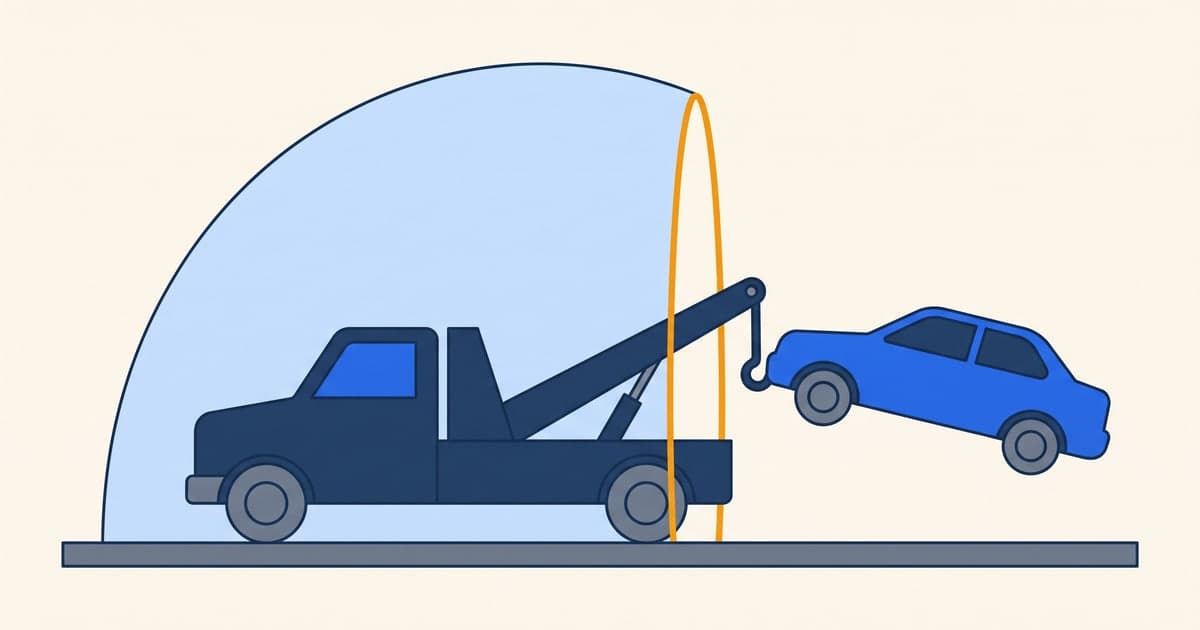
Texas sets the requirement by the type of tow, not the truck — $500,000 for an incident management tow, $300,000 for a consent tow, which specifies no on-hook cover at all.
Tow Truck Insurance Requirements | FMCSA & State Rules
vehicle types
April 21, 2026
Last verified September 21, 2026
9 minutes
Compliance
RequiredQuick answer
Required — and in Texas the limit follows the type of tow, not the truck performing it.
- 16 Tex. Admin. Code § 86.400 sets $500,000 for incident management towing but $300,000 for consent and private property towing.
- Consent towing is the only Texas category with no specified cargo or on-hook minimum.
- On-hook coverage is separate from commercial auto liability, which excludes property in your care, custody and control.
- Arkansas scales on-hook by duty class — $50,000 light, $100,000 medium, $200,000 heavy — under 27 CAR § 170-109.
- Interstate for-hire towing falls under the federal $750,000 floor in 49 C.F.R. Part 387, and motor club contracts commonly ask for $1,000,000.
At a glance
- Texas — incident management towing
- $500,000Per tow truck per incident
- Texas — consent towing
- $300,000No cargo minimum specified
- Texas — cargo / on-hook
- $50,000Incident and private property tows
- Arkansas — on-hook, heavy duty
- $200,000$50K light, $100K medium
- Arkansas — garagekeepers
- $50,000Nonconsent towing businesses
- Federal interstate floor
- $750,00049 C.F.R. Part 387
Checked against 16 Tex. Admin. Code § 86.400 — Insurance Requirements, Tow Truck Permits and 1 more source3 corrections on record, latest September 30, 2026
Not legal or insurance advice. This guide summarises publicly available requirements only. Always verify with your state's Department of Insurance or a licensed professional. Full disclaimer
Tow Truck Insurance — Why Standard Commercial Auto Is Not Enough
Tow truck operators carry a more complex insurance obligation than almost any other commercial vehicle category. A plumber's work van requires commercial auto and general liability. A tow truck requires those coverages — plus on-hook towing coverage for every vehicle in transport, garagekeepers liability for every vehicle stored at an impound lot, and an MCS-90 endorsement if operating interstate under FMCSA authority. Missing any one layer leaves an operator personally exposed on the claim types most likely to occur in the towing trade. State licensing boards, FMCSA registration requirements, and motor club dispatch contracts (AAA, Agero, Urgently) each impose their own insurance requirements — and the combination creates a de facto coverage standard that most operating tow businesses cannot avoid.
Quick Answer: Tow Truck Insurance Requirements at a Glance
| Question | Answer |
|---|---|
| Is commercial auto required? | Yes — personal auto policies explicitly exclude commercial towing |
| FMCSA minimum (interstate, for-hire) | $750,000 at 10,001+ lbs; $300,000 if every vehicle in the fleet is under 10,001 lbs (49 CFR 387.9, 387.303) |
| State intrastate minimums | $300,000–$750,000 — and Texas sets it by type of tow, not truck weight |
| On-hook towing required? | Required by motor club contracts; standard commercial auto excludes it |
| Garagekeepers required? | Required by most state towing/storage licenses |
| MCS-90 endorsement? | Required for all FMCSA-registered interstate operators |
| Surety bond required? | Yes — $10,000–$25,000 in most licensed states |
| Workers' compensation required? | Yes — once the state threshold is met; 1–5 employees by state, optional in Texas |
Commercial Auto Liability — The Foundation
Every tow truck operating for hire requires commercial auto liability insurance. Personal auto policies contain explicit commercial use exclusions — a tow truck driver whose only policy is personal auto has no coverage when a commercial towing accident occurs. The claim will be denied at the first notice of loss.
FMCSA interstate minimum under 49 CFR Part 387:
- $750,000 for for-hire carriers operating vehicles of 10,001 lbs GVWR or more across state lines
- $300,000 for a for-hire carrier with operating authority whose fleet includes only vehicles under 10,001 lbs (49 CFR 387.303(b)(1))
- Hazardous materials towing: $1,000,000–$5,000,000 depending on cargo type
State intrastate minimums — operators towing only within one state are regulated by state law, not FMCSA:
| State | Intrastate Minimum | Authority |
|---|---|---|
| California | $750,000 | CPUC General Order 173 |
| New York | $300,000–$1,500,000 | NYSDOT; NYC operations at the high end |
| Texas | $300,000–$500,000 | TxDMV, weight-class dependent |
| Florida | $300,000 | FDOT |
| Illinois | $300,000 | ILCC |
| Georgia | $300,000 | GDVS |
Motor clubs and municipal police rotation contracts often require $1,000,000 regardless of the applicable state floor, because consistent limits simplify contractor credentialing across multi-state dispatch networks.
MCS-90 Endorsement
Any tow truck registered with FMCSA for interstate operations must carry an MCS-90 endorsement on the commercial auto policy. The MCS-90 is a federally mandated form under 49 CFR Part 387 that makes the insurer a guarantor of the federal minimum — the insurer must pay a valid third-party claim up to the required limit even if the operator has otherwise voided the policy through a violation. The insurer may then seek reimbursement from the operator. The endorsement is filed directly by the insurer with FMCSA through the Unified Registration System and cannot be self-filed.
The Limit Can Follow the Tow, Not the Truck
Most guidance presents tow truck minimums as a single state figure. In the states that regulate towing most closely, that is not how the rule is written — the required limit depends on what kind of tow you are performing.
Texas is the clearest case. Under 16 Tex. Admin. Code § 86.400, the same wrecker carries different obligations on different jobs:
| Type of tow | Liability insurance | Cargo / on-hook |
|---|---|---|
| Incident management towing | $500,000 per tow truck per incident | $50,000 per tow truck per incident |
| Private property towing | $300,000 per tow truck per incident | $50,000 per tow truck per incident |
| Consent towing | $300,000 per tow truck per incident | None specified |
Two consequences catch operators out.
The same truck needs different cover on different jobs. A wrecker clearing a motorway collision is doing incident management towing and needs $500,000. The same wrecker later that day, collecting a car whose owner called for it, is doing consent towing and needs $300,000. The truck did not change; the legal minimum did.
Consent towing is the only one of the three with no cargo requirement. Tow a car at its owner's request, damage it in transit, and Texas does not require you to hold on-hook coverage for that job at all — even though the customer's vehicle is the single most likely thing to be damaged in towing. Texas also requires the liability cover to be written as a combined single limit, and carriers must give the state thirty days' notice before cancelling.
Arkansas scales on-hook to what you can lift
Where Texas ties the figure to the job, Arkansas ties it to the equipment. Under 27 CAR § 170-109, each tow vehicle must carry cargo or on-hook insurance of:
| Duty class | Minimum on-hook |
|---|---|
| Light duty | $50,000 |
| Medium duty | $100,000 |
| Heavy duty | $200,000 |
The logic is plain once stated: a heavy wrecker can pick up a loaded tractor-trailer, so the thing in its custody is worth four times what a light-duty truck can lift. Arkansas additionally requires nonconsent towing businesses to hold garagekeepers liability of not less than $50,000 covering personal injury and property damage at the storage facility, and applies the same $50,000 floor to vehicle immobilisation companies.
The practical lesson for any operator: do not ask "what does my state require for a tow truck". Ask what it requires for the kind of towing you actually do, and whether the cargo figure moves with the truck or with the job.
On-Hook Towing Coverage
On-hook towing coverage — sometimes called inland marine cargo insurance for the towing trade — covers damage to the customer's vehicle while it is in the tow truck's care, custody, and control during transport. Standard commercial auto liability does not cover the towed vehicle because it is cargo in the operator's possession, not third-party property damaged by an accident.
What on-hook covers:
- Damage to the towed vehicle while attached and in transport
- Fire, theft, collision, and vandalism while the vehicle is on the hook
- Loading and unloading damage
What on-hook does not cover:
- Pre-existing damage to the towed vehicle before hookup
- Mechanical failure of the towed vehicle unrelated to the towing operation
- Vehicles stored at the facility after being unhooked (covered by garagekeepers)
Typical limits: $50,000–$250,000 per occurrence. Light-duty towers handling passenger cars may be adequately covered at $100,000; heavy-duty wreckers recovering commercial trucks and motorhomes routinely need $250,000 or higher given the replacement value of those vehicles.
AAA, Agero, Urgently, and similar motor club dispatch networks require proof of on-hook coverage — typically $75,000–$100,000 minimum per occurrence — as a condition of network membership. Without it, the operator cannot participate in dispatch programs that represent a significant share of call volume for most towing businesses.
Garagekeepers Liability — Impound and Storage Coverage
Garagekeepers liability covers damage to customer vehicles stored at a towing company's impound lot, storage yard, or service facility. This is separate from on-hook coverage (which applies during transport) and from commercial auto (which covers the tow truck itself).
Two policy forms:
- Direct primary: Pays the vehicle owner's claim regardless of whether the operator is legally at fault — the standard required by most state storage licensing regulations
- Legal liability: Pays only if the operator is found legally negligent — less expensive but leaves the operator exposed when fault is disputed
Most state towing license statutes hold the towing company financially responsible for vehicles stored under lien-law authority (police impounds, abandoned vehicle holds). Direct primary garagekeepers satisfies that obligation; legal liability form often does not.
Typical limits: $100,000–$500,000 per occurrence. Impound operations holding high-value vehicles, or with large lot capacity, need limits at the higher end. A single hail event or lot fire can generate simultaneous claims across dozens of stored vehicles.
Surety Bond Requirements
Most states with towing company licensing require a surety bond as a condition of the license. The bond is consumer protection — it provides a fund that compensates vehicle owners harmed by a towing company's regulatory violation, without requiring the owner to pursue civil litigation.
| State | Bond Amount | Authority |
|---|---|---|
| California | $25,000 (BCP Consumer Recovery Fund contribution) | BHFTI |
| New York | $25,000 | NYSDMV |
| Texas | $10,000 | TxDMV |
| Florida | $10,000 | DHSMV |
| Illinois | $10,000 | Secretary of State |
| Georgia | $10,000 | GDVS |
The bond is not the operator's liability insurance — it is a consumer protection mechanism. A paid bond claim reduces the available balance; the operator must restore the bond to full face value before the license can be renewed.
Workers' Compensation Requirements
Any towing company with employees — drivers, dispatchers, lot attendants — must carry workers' compensation once it meets the state's threshold — one employee in most states, up to five in a few. Texas makes it optional for private employers. Towing and roadside recovery is classified as a high-risk occupation: drivers work on live traffic lanes, operate chains and winches under load, perform heavy recovery at night and in adverse weather, and are struck by passing vehicles at rates that put the occupation among the most hazardous in the transportation sector.
National Bureau of Labor Statistics injury and fatality data consistently rank tow truck operators among the highest-risk occupations — comparable to logging and roofing. Workers' comp premiums for tow truck drivers reflect that classification, typically running $15–$30 per $100 of payroll, significantly above rates for general trucking or office-based transportation work.
Who Must Carry Tow Truck Insurance?
FMCSA-Registered Interstate Operators
Any for-hire towing company that crosses state lines must register with FMCSA, obtain a USDOT number and operating authority, and carry commercial auto at the federal minimum ($750,000 for vehicles of 10,001 lbs or more) with an MCS-90 endorsement on the policy; the insurer files a BMC-91 or BMC-91X certificate with FMCSA. A BOC-3 process agent filing is also required.
State-Licensed Intrastate Operators
States with towing company licensing — California, New York, Texas, Florida, and most others — require commercial auto at the state minimum, on-hook coverage, garagekeepers liability (for storage operators), and a surety bond as conditions of the operating license or permit.
Motor Club Dispatch Contractors
AAA, Agero, Urgently, Road America, and similar networks verify insurance before adding a company to their dispatch roster. Typical requirements: $1,000,000 commercial auto, $100,000 on-hook per occurrence, $100,000 garagekeepers per occurrence, workers' compensation, and a certificate of insurance naming the motor club as additional insured.
Police Rotation Programs
Municipalities that operate police-rotation towing programs — where companies take turns handling accident scene recoveries and police-ordered impounds — set their own insurance requirements as a condition of rotation list placement. Most require $1,000,000 commercial auto and active garagekeepers coverage, since the municipality can be a co-defendant in impound storage disputes.
Penalties for Non-Compliance
Operating a tow truck for hire without required insurance exposes an operator to multiple simultaneous consequences:
- License suspension or revocation by the state towing authority or PUC
- FMCSA out-of-service order for interstate operators running without the required operating authority (49 CFR 392.9a), and civil penalties
- Personal civil liability for all damages in any accident, with no insurer to pay or defend the claim
- Contract termination by motor clubs and municipal dispatch programs upon discovery of lapsed coverage
- Criminal penalties in states where operating without commercial insurance is a misdemeanor offense (California, Illinois, New York)
Misclassifying drivers as independent contractors to avoid workers' compensation is one of the most commonly audited violations in commercial trucking. State labor departments that find misclassification can impose back premiums, fines, and penalties assessed retroactively across the full audit period.
How to Comply: Step-by-Step for Tow Truck Operators
Step 1: Determine whether FMCSA registration is required
If any tow crosses a state line, FMCSA registration is required. Obtain a USDOT number and — if operating as a for-hire carrier — an MC number. Ensure the commercial auto policy includes the MCS-90 endorsement, and that your insurer has filed the BMC-91 or BMC-91X certificate with FMCSA before the first interstate run.
Step 2: Obtain commercial auto liability at the required minimum
Purchase a commercial auto policy listing each tow truck by VIN. For interstate operators the floor is $750,000; for intrastate, confirm the state-specific minimum with the state DOT or PUC. If motor club or municipal contracts require $1,000,000, purchase at that level regardless of the regulatory floor.
Step 3: Add on-hook towing coverage sized to your fleet
Select on-hook limits based on the highest-value vehicles you typically tow. Light-duty passenger-car towers typically need $100,000; heavy-duty wreckers recovering semi-trucks and specialty equipment need $250,000 or higher. Motor club membership minimum requirements set a floor of $75,000–$100,000 per occurrence.
Step 4: Add garagekeepers liability if you store vehicles
If vehicles remain in your custody at a yard or lot after being unhooked, add garagekeepers liability in direct primary form. Confirm the required form and minimum limit with your state towing license authority before purchasing — some states specify form and amount in their regulations.
Step 5: Post your surety bond and obtain your state operating permit
Identify your state's towing licensing authority and required bond amount. Purchase the bond from a licensed surety company and file it with the licensing authority. Allow 2–4 weeks for processing before the license is issued.
Step 6: Add workers' compensation before the first employee starts
Workers' compensation must be in force before any employee begins work. Obtain coverage through your state's assigned risk pool or a commercial carrier writing trucking workers' comp. Ensure drivers are classified as employees rather than independent contractors — misclassification in the towing sector is one of the most aggressively audited labor department violations in commercial transportation.
Tow Truck vs. Related Operations: Insurance Comparison
| Operation | Commercial Auto Min. | On-Hook | Garagekeepers | FMCSA Required? |
|---|---|---|---|---|
| Light-duty tow (intrastate) | $300,000–$500,000 | Required by contracts | If storing vehicles | No |
| Heavy-duty wrecker (intrastate) | $500,000–$750,000 | Required by contracts | If storing vehicles | No |
| Interstate tow operator | $750,000 | Required by contracts | If storing vehicles | Yes |
| Auto transport carrier | $750,000 | N/A (separate cargo policy) | No | Yes |
| Auto repair shop | $300,000 | No | Yes (garage liability) | No |
| Roadside assist (no tow) | $300,000 | No | No | No |
The single sharpest distinction between tow truck insurance and standard commercial auto is the on-hook exposure: every vehicle in transit is cargo under the operator's care, and standard commercial auto explicitly excludes that liability.
FAQ
Do tow trucks need commercial auto insurance?
Yes. Personal auto policies explicitly exclude commercial towing operations — a claim filed under a personal policy for a commercial towing accident will be denied at first notice. Every tow truck operating for hire requires a commercial auto policy listing the vehicle by VIN.
What is the FMCSA insurance requirement for tow trucks?
Under 49 CFR Part 387, for-hire tow trucks and wreckers of 10,001 lbs GVWR or more operating in interstate commerce must carry at least $750,000 in commercial auto liability; a for-hire carrier whose fleet has only vehicles under 10,001 lbs needs $300,000. The policy must include the MCS-90 endorsement, and the insurer files a BMC-91 or BMC-91X certificate with FMCSA.
What is on-hook towing insurance and why does commercial auto not cover it?
On-hook insurance covers damage to the vehicle being towed while it is attached to and transported by the tow truck. Standard commercial auto liability covers bodily injury and property damage the tow truck causes to others — it does not cover property in the operator's care, custody, and control. A vehicle on the hook is legally cargo; cargo requires its own coverage.
What is garagekeepers liability and who needs it?
Garagekeepers liability covers damage to customer vehicles stored at an impound lot or storage facility — fire, theft, vandalism, weather, or collision on the lot. Any towing company that holds vehicles overnight or longer needs it. Most state towing licenses require direct primary form, which pays the vehicle owner regardless of fault.
What is the MCS-90 endorsement?
The MCS-90 is a federal endorsement required under 49 CFR Part 387 for all FMCSA-registered carriers. It makes the insurer a guarantor of the federal minimum liability — the insurer must pay a qualifying third-party claim up to the required limit even if the operator has voided the policy through a violation. The endorsement stays on the policy as the carrier's proof of financial responsibility (49 CFR 387.7(d)); what the insurer files with FMCSA is the BMC-91 or BMC-91X certificate.
Do tow truck operators need a surety bond?
In most states with towing company licensing, yes — bond amounts typically range from $10,000 to $25,000. The bond protects consumers if the towing company violates state licensing regulations and is separate from liability insurance. A bond claim reduces the available balance; the operator must restore the full amount before license renewal.
What insurance do I need to join a motor club dispatch network?
AAA, Agero, Urgently, and similar networks typically require $1,000,000 commercial auto liability, $75,000–$100,000 on-hook per occurrence, $100,000 garagekeepers per occurrence, workers' compensation for all employees, and a certificate of insurance naming the motor club as additional insured. These limits often exceed the applicable state regulatory minimum.
Can I classify my drivers as independent contractors to avoid workers' comp?
Misclassifying employees as independent contractors to avoid workers' compensation is one of the most aggressively enforced violations in commercial transportation. State labor departments audit towing companies and can impose back premiums, fines, and penalties across the full audit period if misclassification is found. Drivers who are controlled by the company in scheduling, dispatch, and vehicle assignment are typically employees under state workers' comp classification rules regardless of how the contract is written.
Sources
- Federal Motor Carrier Safety Administration — 49 CFR Part 387, Minimum Levels of Financial Responsibility for Motor Carriers
- California Public Utilities Commission — General Order 173, Tow Truck Operator Licensing and Insurance Requirements
- Texas Department of Motor Vehicles — Towing and Storage Registration and Insurance Requirements
Last verified: September 2026
Sources: 16 Texas Administrative Code § 86.400 (Insurance Requirements — Tow Truck Permits); 27 Code of Arkansas Rules § 170-109 (Insurance Requirements); FMCSA financial responsibility minimums, 49 C.F.R. Part 387
Important Disclaimer
This guide provides general information about insurance requirements based on publicly available sources as of the "Last verified" date above. It is not legal, insurance, or financial advice. Requirements, penalties, and statutes can change; individual circumstances vary. Always confirm current rules with your state's Department of Insurance or DMV, and consult a licensed insurance professional for advice specific to your situation.
Sources
Everything above is drawn from the primary regulators below. Requirements change — check the source before you act on it.
- 16 Tex. Admin. Code § 86.400 — Insurance Requirements, Tow Truck Permits — The three towing categories and their separate liability and cargo minimums
- 27 CAR § 170-109 — Arkansas Towing and Recovery Board, Insurance Requirements — On-hook minimums by duty class and the $50,000 garagekeepers floor
Regulators for this topic
- Federal Motor Carrier Safety Administration (FMCSA) — Federal motor carrier insurance filing requirements
- National Highway Traffic Safety Administration (NHTSA) — Federal vehicle safety regulation
- National Association of Insurance Commissioners (NAIC) — Nationwide regulator association and consumer guidance
- Insurance Information Institute (III) — Industry reference data and coverage explainers

About Dana Whitfield
Dana covers insurance requirements for motorcycles, boats, RVs, ATVs, and other recreational and specialty vehicles, working state by state through DMV codes, watercraft titling agencies, and state insurance department filings to keep coverage minimums current.
Vehicle & Recreational Insurance Research LeadMotorcycle, boat, RV, ATV, and other vehicle-type insurance requirements by state
A named research persona representing our editorial process, not an individually licensed insurance professional. How we work.
Related Articles
More insurance requirement guides you may find useful
vehicle typesCompliance
9 minutes
Amazon Relay Insurance Requirements: $1M Auto, $100K Cargo and What FMCSA Doesn't Require
Relay carriers need $1M auto, $100K cargo, $1M/$2M general liability and 180 days of authority. Federal law asks for $750K and no cargo. US, Canada and UK compared.
commercial auto
Read guide
vehicle typesMinimum Coverage
11 minutes
School Bus Insurance Requirements by State: From $10,000 to $2 Million
Illinois and Kentucky require $2M per school bus; Montana's 1971 floor is $10,000 per person. Florida scales it at $5,000 a seat. 15 states verified at statute.
all states
Read guide
vehicle typesMinimum Coverage
10 minutes
Limousine and Party Bus Insurance Requirements: How Seat Count Sets the Minimum
An eight-seat stretch SUV needs $500,000 in Colorado, $750,000 in California and $1.5M plus a $1.5M SUM layer in New York. Federal, state and city tiers compared.
all states
Read guide
Popular Articles
6 articlesMinimum Auto Insurance Requirements by State: All 50 States
15 minutescompare-coverage
LLC Insurance Requirements by State: Complete Guide
15 minutesbusiness-insurance
DOT Insurance Requirements: $750K to $5M by Cargo, MCS-90 and BMC-91
17 minutescompliance-guides
Virginia Auto Insurance Requirements: 50/100/25 and the End of the UMV Fee
14 minutesauto-insurance
SR-22 Requirements: Filing Periods, Costs and What Restarts the Clock
15 minutescompliance-guides
Florida Leased Car Insurance Requirements: Why Leases Demand 100/300/50
9 minutesauto-insurance