
SR-22 is a certificate proving you carry required auto insurance. Learn when it's required, how long you need it, costs, and how to file in your state.
SR-22 Requirements: Filing Periods, Costs and What Restarts the Clock
compliance guides
December 8, 2025
Last verified September 18, 2026
15 minutes
SR-22
ConditionalQuick answer
Only after a triggering violation, and only in states that use it — an SR-22 is a certificate your insurer files with the state, not an insurance policy.
- Florida and Virginia use the FR-44, with higher limits, after a DUI; see our FR-44 guide.
- Driving uninsured, DUI and license suspensions are common triggers in states that use SR-22.
- The filing period is set by each state; South Carolina, for example, lets proof be cancelled after three conviction-free years (S.C. Code § 56-9-620).
- A lapse in the underlying policy is reported to the state, so keep the policy in force for the whole period.
At a glance
- Is it insurance?
- NoA certificate your insurer files with the state
- After a DUI in FL or VA
- FR-44 instead
- Filing period
- Set by each stateSC: 3 conviction-free years
Checked against S.C. Code § 56-9-620 — Cancellation of proof of financial responsibility and 1 more source1 correction on record, latest October 12, 2026
Not legal or insurance advice. This guide summarises publicly available requirements only. Always verify with your state's Department of Insurance or a licensed professional. Full disclaimer
Quick Answer: What Is SR-22 Insurance?
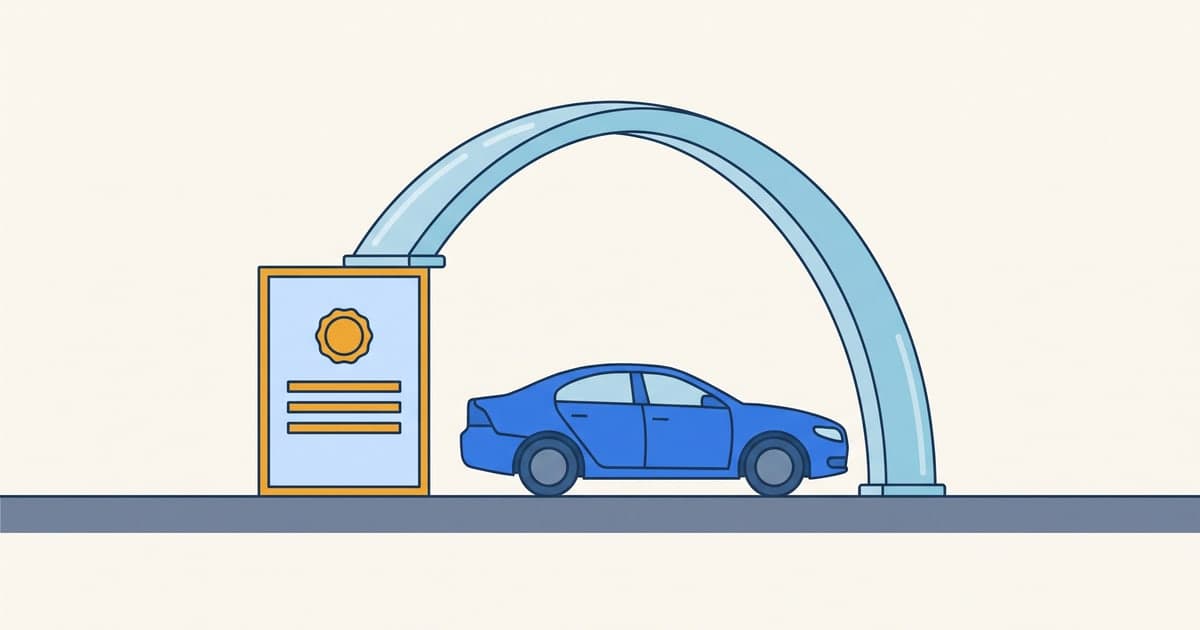
SR-22 is not actually insurance—it's a certificate proving you carry state-required minimum liability coverage. Your insurance company files this form with your state's DMV to verify you're insured after certain violations. Think of it as proof of financial responsibility.
SR-22 Requirements at a Glance
| Factor | Typical Requirement |
|---|---|
| Filing period | 3 years (most states) |
| Coverage required | State minimum liability |
| Filing fee | $15-$50 one-time |
| Premium increase | 30-80% average |
| Lapse penalty | Clock restarts |
When Is SR-22 Required?
Common Reasons for SR-22 Requirements
| Violation | SR-22 Likely Required |
|---|---|
| DUI/DWI | Usually, in states that use SR-22 (Florida and Virginia use FR-44 instead) |
| Driving without insurance | Yes |
| Multiple at-fault accidents | Often |
| Reckless driving | Often |
| License suspension | Usually |
| Too many points | Varies by state |
| Unpaid judgments from accidents | Yes |
State-Specific Triggers
Virginia and Florida use FR-44 instead of SR-22 for DUI offenses—requiring higher coverage limits.
Not every state uses the SR-22 form. Some use different proof-of-insurance systems, so if your state has no SR-22, ask the DMV what proof it accepts instead. Whatever the form, the policy behind it must meet at least your state's liability minimum; see our minimum auto insurance by state table.
How SR-22 Works
Step 1: Get the Requirement
After certain violations, your state's DMV sends a letter requiring you to file an SR-22 before reinstating your license.
Step 2: Contact Your Insurer
Ask your current insurer to file an SR-22. Not all companies offer SR-22 filings—if yours doesn't, you'll need a new policy.
Step 3: Insurer Files the Form
Your insurance company files the SR-22 electronically with your state. This typically takes 1-3 business days.
Step 4: Maintain Continuous Coverage
You must maintain uninterrupted coverage for the entire filing period (usually 3 years). Any lapse restarts the clock.
Step 5: SR-22 Expires
After completing the filing period, you can request removal. Your state notifies you when it's no longer required.
SR-22 Filing Periods by State
The period is set by each state, and the clock and conditions differ. One example, from the statute: in South Carolina, proof of financial responsibility may be cancelled after three years if, during those three years, the department has received no record of a conviction requiring proof (S.C. Code § 56-9-620).
Three years is a common period, but it is not universal and some offenses carry longer ones, so get the exact period and start date from your state DMV. After a DUI in Florida or Virginia, see our FR-44 guide; for drivers without a car of their own, see non-owner auto insurance.
Types of SR-22 Certificates
Operator's Certificate (Most Common)
- Covers you when driving any vehicle
- Required if you don't own a car but need to drive
- Also called "non-owner SR-22"
Owner's Certificate
- Covers vehicles you own and register
- The standard SR-22 for most drivers
Owner-Operator Certificate
- Covers both owned vehicles and any vehicle you drive
- Most comprehensive coverage
How Much Does SR-22 Cost?
SR-22 Filing Fee
| Fee Type | Cost Range |
|---|---|
| One-time filing fee | $15-$50 |
| Reinstatement fee (DMV) | $50-$250 |
Insurance Premium Increases
The filing fee is minimal—the real cost is higher insurance premiums:
| Driver Profile | Average Increase |
|---|---|
| First DUI | 80-90% |
| Driving uninsured | 30-50% |
| Multiple violations | 100%+ |
| Reckless driving | 50-70% |
Example: If your premium was $1,200/year, a DUI with SR-22 could raise it to $2,200-$2,400/year.
Total Cost Over Filing Period
| Scenario | Annual Premium | 3-Year Total Cost |
|---|---|---|
| Before SR-22 | $1,200 | $3,600 |
| With SR-22 (DUI) | $2,300 | $6,900 |
| Additional cost | — | $3,300 |
What Happens If SR-22 Coverage Lapses?
Immediate Consequences
- Insurer notifies state — Insurance companies must report cancellations within 15-30 days
- License suspension — Your state suspends your license again
- Clock restarts — The filing period starts over from day one
- Additional penalties — Fines, fees, and potentially longer filing requirements
Avoiding Lapses
- Set up automatic payments
- Pay premiums before due date (not on due date)
- Never cancel old policy until new SR-22 is filed
- Keep buffer time when switching insurers
How to Get SR-22 Insurance
1. Check If Your Current Insurer Files SR-22
Many standard insurers (State Farm, GEICO, Progressive, Allstate) offer SR-22 filings.
2. If Not, Find a New Insurer
Some companies specialize in high-risk drivers:
- The General
- Dairyland
- Bristol West
- Acceptance Insurance
3. Request the SR-22 Filing
Provide:
- Your driver's license number
- The state requiring SR-22
- The reason for requirement (DUI, uninsured, etc.)
4. Pay the Filing Fee
Typically $15-$50 one-time fee.
5. Confirm Filing
Get written confirmation the SR-22 was submitted. Don't drive until confirmed.
SR-22 vs. FR-44 (Florida & Virginia)
Virginia and Florida require FR-44 instead of SR-22 for DUI/DWI convictions:
| Requirement | SR-22 | FR-44 |
|---|---|---|
| Liability limits | State minimum | Higher than minimum |
| Florida | 10/20/10 | 100/300/50 |
| Virginia | 50/100/25 | 100/200/50 (double the minimum) |
| Filing period | 3 years | 3 years |
FR-44 costs significantly more due to the higher coverage requirements.
Non-Owner SR-22
If you don't own a vehicle but need to reinstate your license:
When You Need It
- License suspended but you don't own a car
- Need to drive borrowed vehicles or rentals
- Applying for license reinstatement
What It Covers
- Liability coverage when driving any vehicle
- Does NOT cover any vehicle you own or regularly use
Cost
Non-owner SR-22 policies are typically cheaper: $300-$600/year.
FAQ
How long do I need SR-22 insurance?
Most states require 3 years of continuous SR-22 coverage. Some violations require longer periods. The clock restarts if your coverage lapses for any reason.
Will SR-22 show on my driving record?
The SR-22 itself doesn't appear on your driving record, but the underlying violation (DUI, driving uninsured, etc.) does. Insurers will see both when checking your record.
Can I get SR-22 with a suspended license?
Yes—in fact, you typically need to file SR-22 to get your license reinstated. Many people file SR-22 while their license is still suspended.
Does SR-22 follow me if I move to another state?
Yes. If you move, you must maintain SR-22 in your new state until the original filing period ends. Some states have reciprocity agreements; others require a new filing.
Can I remove SR-22 early?
Generally no. You must complete the entire filing period. Early removal results in license suspension. Only the state can authorize early termination (rare).
What if I can't afford SR-22 insurance?
Options include:
- Non-owner SR-22 (if you don't own a car)
- High-risk insurers with payment plans
- State-sponsored programs (some states)
- Improving your driving record for better rates
Do all insurance companies offer SR-22?
No. Some insurers don't write high-risk policies. If your current company doesn't offer SR-22, you'll need to find one that does. This may mean higher premiums.
Important Disclaimer
This guide provides general information about SR-22 requirements based on publicly available sources. This is not legal advice. SR-22 requirements vary by state and individual circumstances. Always verify current requirements with your state's DMV and consult with a licensed insurance professional for advice specific to your situation.
Last verified: September 2026
Sources: State DMV offices, Insurance Information Institute
Sources
Everything above is drawn from the primary regulators below. Requirements change — check the source before you act on it.
- S.C. Code § 56-9-620 — Cancellation of proof of financial responsibility — Proof may be cancelled after three years without a conviction requiring proof
- Fla. Stat. § 324.023 — Financial responsibility for DUI — FR-44 limits after a DUI conviction
Regulators for this topic
- National Association of Insurance Commissioners (NAIC) — Nationwide regulator association and consumer guidance
- Insurance Information Institute (III) — Industry reference data and coverage explainers

About Jordan Ellis
Jordan focuses on regulatory compliance topics such as SR-22/FR-44 filings and DOT/FMCSA rules, professional liability and errors-and-omissions requirements by profession, state-by-state coverage comparisons, and travel insurance rules, drawing primarily on state insurance department bulletins and federal regulatory text.
Compliance, Liability & Travel Insurance Research LeadSR-22/FR-44 and DOT compliance, professional liability, coverage comparisons, and travel insurance
A named research persona representing our editorial process, not an individually licensed insurance professional. How we work.
Related Articles
More insurance requirement guides you may find useful
compliance guidesState Laws
8 minutes
Do You Need Insurance to Get a Driver's License? The 4 States That Check
NC, SC, Texas and Louisiana won't issue a licence without proof of insurance or a no-vehicle statement. SC and Louisiana check renewals too.
all states
Read guide
compliance guidesState Laws
9 minutes
Insurance for Temporary Tags and Trip Permits: Who Checks, in 13 States
Every state requires insurance to drive on a temporary tag, but only some check first. Virginia names temporary plates in its uninsured-driving offence.
all states
Read guide
compliance guidesCompliance
9 minutes
Aerial Applicator Insurance Requirements: The States That Make Crop Dusters Cover Drift
The FAA requires no insurance for crop dusting; states do, from $25,000 in Kansas to $400,000 in Colorado. Florida and Oklahoma require drift cover, Colorado doesn't.
all states
Read guide
Popular Articles
6 articlesMinimum Auto Insurance Requirements by State: All 50 States
15 minutescompare-coverage
LLC Insurance Requirements by State: Complete Guide
15 minutesbusiness-insurance
DOT Insurance Requirements: $750K to $5M by Cargo, MCS-90 and BMC-91
17 minutescompliance-guides
Virginia Auto Insurance Requirements: 50/100/25 and the End of the UMV Fee
14 minutesauto-insurance
SR-22 Requirements: Filing Periods, Costs and What Restarts the Clock
15 minutescompliance-guides
Insurance on a Parked Car: Plate Surrender and Non-Use Rules in 13 States
10 minutesauto-insurance