
Auto detailers face the same care-custody-control gap as mechanics — paint and upholstery damage during detailing isn't covered by standard general liability without a garagekeepers endorsement.
Auto Detailing Insurance Requirements
business insurance
July 7, 2026
Last verified July 7, 2026
10 minutes
ConditionalQuick answer
Conditional — detailing is unlicensed in most states and not directly mandated, but dealership and fleet contracts require garagekeepers and general liability before you touch a car.
- Garagekeepers is the cover that actually responds to the trade's most common claim — paint, upholstery or interior damage during the detail. General liability does not reach it.
- Products and completed operations matters here because chemical residue damage often surfaces days after the job.
- A mobile rig carrying water tanks, pressure washers and generators needs commercial auto, not a personal policy.
- App-based detailing marketplaces increasingly set their own proof-of-cover requirement.
At a glance
- State licence
- Not in most states
- General liability
- $500K–$1MPer occurrence
- GL aggregate
- $1M–$2M
- Garagekeepers
- EssentialCustomer's vehicle in your care
- Mobile rigs
- Commercial auto
Not legal or insurance advice. This guide summarises publicly available requirements only. Always verify with your state's Department of Insurance or a licensed professional. Full disclaimer
A Buffer Wheel Burns Through Paint Faster Than It Takes to Notice
An auto detailer runs a rotary buffer over a client's hood for a few seconds too long and burns through the clear coat down to bare metal. A mobile detailing van's water tank leaks onto a client's driveway and stains the concrete. A chemical degreaser splashes and damages leather upholstery beyond repair. Each of these is a routine claim in the detailing trade, and each falls into the same coverage gap that affects auto mechanics: the vehicle being detailed is in the detailer's care, custody, or control, which standard general liability insurance excludes by default. Most states do not license auto detailing as a regulated trade, so the insurance requirement comes almost entirely from customer expectations, mobile detailing platform requirements, and commercial contracts with dealerships and fleet operators. This guide covers what's actually required, the garagekeepers coverage gap specific to this trade, and how mobile detailing differs from a fixed-location detail shop.
Quick Answer: Auto Detailing Insurance at a Glance
| Factor | Detail |
|---|---|
| State license for auto detailing? | Not in most states — detailing is generally unlicensed as a standalone trade |
| Insurance required by law? | Not directly mandated in most states |
| Dealership and fleet contract requirements | Common — dealerships contracting detailers for lot service typically require proof of garagekeepers and general liability coverage |
| Mobile detailing platform requirements | Increasingly standard for app-based on-demand detailing marketplaces |
| Typical general liability minimum | $500,000–$1,000,000 per occurrence |
| Garagekeepers legal liability | Essential — covers damage to a customer's vehicle while being detailed |
Is Insurance Required for Auto Detailers?
No state broadly licenses auto detailing as a regulated occupation the way it licenses contractors or cosmetologists, so there is no uniform statutory insurance mandate across the trade. The practical requirement instead comes from:
- Dealership and fleet contracts. Auto dealerships that contract independent detailers to prep vehicles for sale, and fleet operators that contract detailing for commercial vehicles, typically require proof of garagekeepers and general liability coverage before granting lot access.
- Mobile detailing platforms. On-demand detailing marketplaces connecting customers to mobile detailers increasingly require contractors to carry proof of coverage before accepting bookings through the platform.
- Commercial property and business park leases. Detailing businesses operating from a fixed location typically need proof of general liability as a condition of a commercial lease, similar to any retail or service tenant.
- Municipal business licensing. Most municipalities require a general business license to operate a detailing business, and some local jurisdictions tie business license issuance to proof of liability coverage for vehicle-related service businesses specifically.
What a Standard General Liability Policy Doesn't Cover
The Care, Custody, and Control Exclusion
As with mobile mechanics, a standard commercial general liability policy excludes damage to property in the detailer's care, custody, or control — meaning the customer's vehicle itself, the exact property most likely to be damaged during detailing work, is not covered by a standard GL policy. Paint damage from an over-aggressive buffer, chemical damage to upholstery, or scratches from improper wash-mitt technique fall into this excluded category without a specific garagekeepers endorsement.
Personal Auto Exclusions
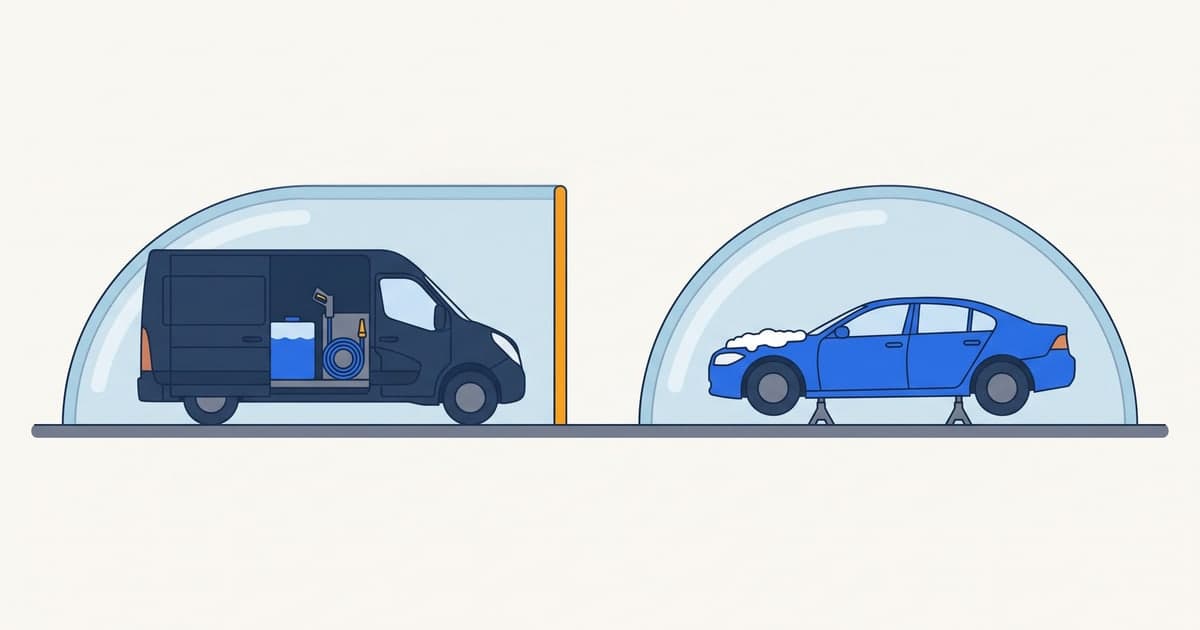
A personal auto policy excludes commercial use. Mobile detailers operating a van or trailer outfitted with water tanks, generators, and detailing equipment need commercial auto coverage — a claim during a service trip in a personally insured vehicle used for business purposes can be denied.
Minimum Required Coverage
General Liability
| Coverage Element | Typical Minimum |
|---|---|
| Per-occurrence limit | $500,000–$1,000,000 |
| Aggregate limit | $1,000,000–$2,000,000 |
| Products/completed operations | Included — covers claims surfacing after the detail is complete, such as a chemical residue causing paint damage discovered days later |
Garagekeepers Legal Liability
Garagekeepers coverage insures a customer's vehicle specifically while it is in the detailer's care, custody, or control. This is the coverage that actually responds to the most common claim type in this trade — paint damage, upholstery damage, or interior staining during the detailing process — which general liability alone will not cover.
Commercial Auto
Mobile detailing vans and trailers carrying water tanks, pressure washers, generators, and chemical supplies require commercial auto liability coverage, typically $500,000–$1,000,000 combined single limit, along with physical damage coverage for the vehicle and its mounted equipment.
Pollution/Environmental Liability
Detailing chemicals — degreasers, tire shine, wheel cleaners — that run off into storm drains or a client's landscaping can trigger environmental liability claims in some jurisdictions with strict runoff regulations. A pollution liability endorsement, while not universally required, addresses a gap standard general liability policies typically exclude.
Who Must Carry This Insurance
- Independent and mobile auto detailers performing paid detailing at a customer's home, workplace, or a dealership lot
- Detailers contracted by auto dealerships for new and used vehicle prep, where proof of garagekeepers and general liability coverage is typically a condition of lot access
- Fleet detailing contractors servicing commercial or rental vehicle fleets, who face higher-value vehicles and correspondingly higher required limits in many contracts
- Fixed-location detail shop owners, who need coverage as a condition of their commercial lease in addition to the trade-specific garagekeepers exposure
Exceptions and Common Situations Without a Mandate
- Occasional, informal detailing for friends or neighbors without compensation falls outside any commercial liability framework.
- Detailers working as W-2 employees of a dealership or detail shop are typically covered under the employer's business policy rather than needing independent coverage.
- States and municipalities without vehicle-service-specific business licensing conditions may not tie business license issuance to proof of insurance, though dealership and platform contract requirements still commonly apply regardless of local licensing rules.
Penalties for Non-Compliance
- Loss of dealership contracts — dealerships requiring proof of garagekeepers and general liability coverage as a lot-access condition will not contract with uninsured detailers
- Platform suspension — mobile detailing marketplaces commonly suspend contractors who let required coverage lapse
- Personal financial exposure for vehicle damage — a detailer without garagekeepers coverage who damages a customer's paint or interior is personally responsible for the repair cost
- Commercial lease default — fixed-location shops operating without required liability coverage can be found in default of their lease terms
How to Get Coverage
Auto detailers typically obtain coverage through a garage liability policy combining general liability and garagekeepers coverage, similar to the package products used by mobile mechanics and auto repair shops, available from insurers specializing in automotive service businesses. Commercial auto coverage for a mobile detailing van or trailer is typically added as a separate line. Dealerships and platforms requiring proof of coverage typically request a certificate of insurance (COI), sometimes naming the dealership as an additional insured for the duration of the service contract.
Comparison: Auto Detailing vs. Mobile Mechanic Insurance
| Factor | Auto Detailing | Mobile Mechanic |
|---|---|---|
| Primary claim type | Paint, upholstery, and interior damage during service | Mechanical failure, electrical fire, road-test accidents |
| Garagekeepers coverage | Essential | Essential |
| Chemical/pollution exposure | Higher — detailing chemicals and runoff | Lower, though solvents and fluids still present |
| Typical GL minimum | $500,000–$1,000,000 | $500,000–$1,000,000 |
| Equipment value carried | Moderate (pressure washers, vacuums, polishers) | Often higher (diagnostic scanners, specialty tools) |
FAQ
Do auto detailers need special insurance beyond general liability?
Yes. Standard general liability excludes damage to a customer's vehicle under the care, custody, and control exclusion. Detailers need garagekeepers legal liability coverage specifically to insure the customer's vehicle while it's being detailed, since paint and interior damage claims are the most common risk in this trade.
Is auto detailing insurance required by law?
Not directly in most states, since auto detailing is generally not a licensed trade. The practical requirement comes from dealership contracts, mobile detailing platforms, commercial leases, and in some municipalities, business license conditions tied to vehicle-service businesses.
What's the most common insurance claim in the detailing business?
Paint damage from aggressive buffing or polishing, chemical damage to upholstery or leather, and staining from improper product use are the most common claims — all of which fall under the care, custody, and control exclusion in a standard general liability policy and require garagekeepers coverage to be covered.
Does my personal auto insurance cover my mobile detailing van?
No. A personal auto policy excludes commercial use. A mobile detailing van equipped with water tanks, generators, and detailing supplies used for paid work needs a commercial auto policy to cover accidents during service trips.
Do dealerships require detailers to carry their own insurance?
Yes, in most cases. Dealerships contracting independent detailers for vehicle prep typically require proof of garagekeepers and general liability coverage before granting access to the lot, and often require the dealership to be named as an additional insured.
Do I need pollution liability coverage as a detailer?
It depends on local regulations and how much runoff exposure the business has. Detailing chemicals that enter storm drains or damage a client's landscaping can trigger environmental liability claims in jurisdictions with strict runoff rules, and a pollution liability endorsement addresses a gap standard general liability typically excludes.
What happens if I damage a customer's vehicle and don't have garagekeepers coverage?
The detailer is personally responsible for the cost of repairing or replacing the damaged paint, upholstery, or interior components, since a standard general liability policy excludes this exposure and no other coverage would respond without a dedicated garagekeepers policy.
Key Takeaways
- Standard general liability excludes damage to a customer's vehicle under the care, custody, and control exclusion — the central coverage gap in this trade, same as in mobile mechanic work.
- Garagekeepers legal liability is the coverage that actually responds to the most common claim type: paint, upholstery, and interior damage during detailing.
- No state broadly licenses auto detailing, so the insurance requirement flows almost entirely from dealership contracts, mobile platforms, and commercial leases rather than a direct statutory mandate.
- Commercial auto coverage for the service vehicle is separate from and in addition to the garage liability policy covering the detailing work itself.
- Pollution liability is a secondary but relevant exposure given the chemicals used in professional detailing work.
Sources
- National Association of Insurance Commissioners (NAIC) — garage liability and garagekeepers coverage overview
- International Detailing Association (IDA) — industry insurance and business practice guidance
- Municipal business licensing offices — vehicle-service business license requirements (jurisdiction-specific)
Last verified: July 2026
Important Disclaimer
This guide provides general information about insurance requirements based on publicly available sources as of the "Last verified" date above. It is not legal, insurance, or financial advice. Requirements, penalties, and statutes can change; individual circumstances vary. Always confirm current rules with your state's Department of Insurance or DMV, and consult a licensed insurance professional for advice specific to your situation.
Sources
Everything above is drawn from the primary regulators below. Requirements change — check the source before you act on it.
Regulators for this topic
- U.S. Small Business Administration (SBA) — Federal small-business insurance guidance
- U.S. Department of Labor — Workers' Compensation — Federal workers' compensation framework
- National Association of Insurance Commissioners (NAIC) — Nationwide regulator association and consumer guidance
- Insurance Information Institute (III) — Industry reference data and coverage explainers

About Priya Anand
Priya researches business formation and contractor licensing rules, working through state licensing board requirements and bonding statutes to explain what coverage a given trade or business type is legally required to carry, sourced from state licensing board publications and business regulation codes.
Business & Contractor Insurance Research LeadSmall business, LLC, and contractor/trade licensing insurance requirements
A named research persona representing our editorial process, not an individually licensed insurance professional. How we work.
Related Articles
More insurance requirement guides you may find useful
business insuranceCompliance
10 minutes
Boxing and MMA Promoter Insurance: $20K Florida to $1M New York
New York requires MMA and boxing promoters to insure each fighter for $1,000,000 in brain injury care; Florida requires $20,000 in medical coverage.
all states
Read guide
business insuranceState Laws
10 minutes
Outfitter Insurance Requirements: $100K Colorado, $500K Oregon
Colorado requires outfitters to carry $100,000 per accident plus a $10,000 bond; Oregon requires $500,000, and Montana defers to federal land permits.
all states
Read guide
business insuranceState Laws
14 minutes
Bounce House Insurance Requirements: $1M by Law, or Exempt by Name
Four states legally require $1,000,000+ liability insurance for bounce house rentals; Florida and Colorado exempt inflatables from that same law.
all states
Read guide
Popular Articles
6 articlesMinimum Auto Insurance Requirements by State: All 50 States
15 minutescompare-coverage
LLC Insurance Requirements by State: Complete Guide
15 minutesbusiness-insurance
DOT Insurance Requirements: $750K to $5M by Cargo, MCS-90 and BMC-91
17 minutescompliance-guides
Virginia Auto Insurance Requirements: 50/100/25 and the End of the UMV Fee
14 minutesauto-insurance
SR-22 Requirements: Filing Periods, Costs and What Restarts the Clock
15 minutescompliance-guides
Aircraft Insurance Requirements by State: Only Minnesota Mandates It
10 minutesvehicle-types