
Standard general liability excludes a customer's vehicle under the care, custody, and control exclusion — mobile mechanics need garagekeepers coverage plus commercial auto, which most repair apps require before onboarding.
Mobile Mechanic Insurance Requirements: Why General Liability Won't Cover the Car You're Working On
contractor insurance
July 7, 2026
Last verified July 7, 2026
10 minutes
ConditionalQuick answer
No dedicated state licence in most states — but garagekeepers liability is effectively mandatory, because general liability excludes the customer vehicle.
- General liability excludes property in your care, custody or control.
- That exclusion covers the exact vehicle you are working on.
- App-based platforms impose their own onboarding minimums.
- Commercial auto is needed for the van or truck you travel in.
At a glance
- Garagekeepers liability
- Effectively required
- General liability alone
- Leaves a gapCare, custody, control
- Commercial auto
- Required for the service vehicle
- State licence category
- Rare
Not legal or insurance advice. This guide summarises publicly available requirements only. Always verify with your state's Department of Insurance or a licensed professional. Full disclaimer
The Vehicle in Your Care, Custody, or Control Isn't Covered by General Liability Alone
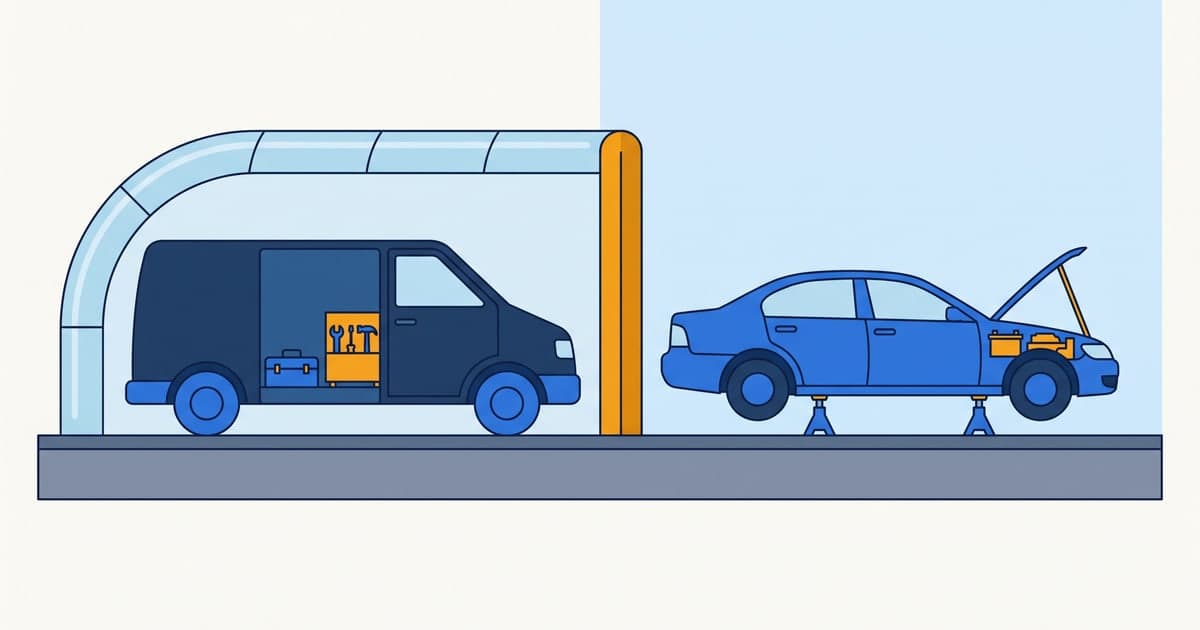
A mobile mechanic pulls into a client's driveway, opens the hood, and takes a customer's vehicle apart to replace a timing belt. If a wiring mistake later causes an electrical fire, or the mechanic backs the client's car into a fence while road-testing it, standard general liability insurance does not respond — the vehicle was in the mechanic's care, custody, or control, a specific exclusion in most general liability policies. Mobile mechanics, who now make up a fast-growing share of the auto repair industry through app-based on-demand platforms, face a distinct liability profile from a fixed-location repair shop, and most states do not license "mobile mechanic" as its own category — the insurance requirement instead flows from platform onboarding rules, customer contracts, and the garagekeepers liability gap that standard business policies leave open. This guide covers what's required, what garagekeepers coverage actually does, and how mobile mechanic insurance differs from a traditional auto repair shop policy.
Quick Answer: Mobile Mechanic Insurance at a Glance
| Factor | Detail |
|---|---|
| State license specifically for "mobile mechanic"? | Not in most states — auto repair is regulated inconsistently, and mobile-specific licensing is rare |
| Insurance required by law? | Varies by state; some states require registered auto repair businesses to carry liability coverage regardless of location model |
| Platform requirements (YourMechanic, Wrench, RepairSmith-style apps) | Nearly universal — proof of general liability and garagekeepers coverage required to be listed |
| Typical general liability minimum | $500,000–$1,000,000 per occurrence |
| Garagekeepers legal liability | Essential — covers damage to a customer's vehicle while in the mechanic's care, custody, or control |
| Commercial auto | Required for the mobile service vehicle itself, plus tools and parts transported |
Is Insurance Required for Mobile Mechanics?
Auto repair licensing varies significantly by state — some states require a registered auto repair dealer (ARD) license or equivalent regardless of whether the business operates from a fixed shop or a mobile service vehicle, and several of those states require proof of liability insurance as part of that registration. Independent of state licensing, insurance becomes a practical requirement through:
- State auto repair dealer registration, where applicable — a subset of states require any business performing paid auto repair, including mobile operations, to register and in some cases show proof of liability coverage.
- On-demand mobile mechanic platforms. App-based marketplaces connecting customers with mobile mechanics almost universally require independent contractors to carry proof of general liability and garagekeepers coverage before being approved to accept jobs through the platform.
- Customer and fleet contracts. Mobile mechanics servicing commercial fleets or working through property management companies (servicing apartment complex parking lots, for example) are frequently required by contract to carry proof of coverage naming the client as an additional insured.
- Parts supplier and manufacturer warranty programs. Some manufacturers and parts distributors require proof of insurance for mechanics performing warranty-covered repairs under a service agreement.
What a Standard General Liability Policy Doesn't Cover
The Care, Custody, and Control Exclusion
Standard commercial general liability policies exclude damage to property in the insured's "care, custody, or control." For a mobile mechanic, this means the exact property most likely to be damaged during a repair — the customer's vehicle — is specifically excluded from a standard GL policy. This is the single most important coverage gap in this trade, and it's the reason garagekeepers legal liability exists as a distinct product.
Personal Auto Exclusions
A personal auto policy excludes commercial use, including a vehicle converted into a mobile repair unit carrying tools, diagnostic equipment, and parts. An accident during a service call in a vehicle covered only by personal auto insurance can result in a denied claim.
Minimum Required Coverage
General Liability
| Coverage Element | Typical Minimum |
|---|---|
| Per-occurrence limit | $500,000–$1,000,000 |
| Aggregate limit | $1,000,000–$2,000,000 |
| Products/completed operations | Included — covers claims arising after the repair is complete, such as a part failure days later |
Garagekeepers Legal Liability
Garagekeepers coverage specifically insures a customer's vehicle while it is in the mechanic's care, custody, or control — filling the exact gap general liability leaves open. Coverage typically comes in two forms: legal liability (pays only if the mechanic is found negligent) and direct primary (pays regardless of fault, subject to policy terms). Mobile mechanic platforms and higher-volume operations increasingly require direct primary coverage given the higher bar to prove negligence in single-vehicle, no-witness settings common to mobile repair work.
Commercial Auto
The mobile service vehicle itself — typically a van or truck outfitted with tools, a compressor, and diagnostic equipment — requires commercial auto liability coverage, commonly $500,000–$1,000,000 combined single limit, along with physical damage coverage for the vehicle and its onboard equipment.
Tools and Equipment Coverage
Mobile mechanics carry several thousand to tens of thousands of dollars in tools and diagnostic equipment in their service vehicle at all times. Inland marine or tool-floater coverage protects this equipment against theft or damage, which a standard commercial auto policy typically does not fully address.
Who Must Carry This Insurance
- Independent mobile mechanics performing paid repairs at a customer's home, workplace, or roadside location
- Mechanics working through on-demand mobile repair platforms, where proof of general liability and garagekeepers coverage is typically a condition of platform approval
- Mechanics servicing commercial fleets or property management clients, who are frequently required by contract to name the client as an additional insured
- Mobile diesel and heavy-equipment mechanics servicing commercial trucking fleets, who typically face higher required limits given the value of the vehicles serviced
Exceptions and Common Situations Without a Mandate
- States without auto repair dealer licensing requirements may not impose a direct state-level insurance mandate on mobile mechanics, though platform and customer-contract requirements still commonly apply.
- Occasional, informal repair work for friends or family without compensation falls outside commercial auto repair liability frameworks entirely.
- Mechanics working exclusively as W-2 employees of a licensed shop that dispatches them to mobile jobs are typically covered under the employer's business policy rather than needing independent coverage, though this should be confirmed directly with the employer.
Penalties for Non-Compliance
- Loss of platform access — mobile mechanic apps commonly suspend or refuse to onboard mechanics without current proof of general liability and garagekeepers coverage
- Personal financial exposure for vehicle damage — a mechanic without garagekeepers coverage who damages a customer's vehicle during a repair is personally responsible for the repair or replacement cost, since general liability will not respond
- State registration issues — in states requiring auto repair dealer registration with an insurance component, operating without coverage can result in fines or registration denial
- Contract termination — fleet and property management clients requiring proof of coverage typically reserve the right to terminate the service agreement for a lapse
How to Get Coverage
Mobile mechanics typically obtain coverage through a garage liability policy — a package product combining general liability, garagekeepers coverage, and commercial auto specifically designed for the auto repair trade, available from insurers specializing in automotive service businesses. Tool and equipment coverage is often added as an inland marine rider. On-demand platforms requiring proof of coverage typically accept a certificate of insurance (COI) as part of the mechanic onboarding process, sometimes with the platform itself facilitating group-rate coverage options for its contractor network.
FAQ
Do mobile mechanics need special insurance beyond general liability?
Yes. Standard general liability excludes damage to a customer's vehicle under the "care, custody, or control" exclusion — mobile mechanics need garagekeepers legal liability coverage specifically to insure the customer's vehicle while it's being worked on, which general liability does not provide.
Is mobile mechanic insurance required by law?
It depends on the state. Some states require any business performing paid auto repair, including mobile operations, to register as an auto repair dealer and show proof of liability coverage. Independent of state law, on-demand platforms and commercial clients almost universally require proof of coverage as a condition of working with them.
What's the difference between garagekeepers legal liability and direct primary coverage?
Garagekeepers legal liability pays only if the mechanic is found negligent for the damage. Direct primary garagekeepers coverage pays regardless of fault, subject to policy terms — a meaningful distinction in mobile repair work, where there are often no witnesses to establish fault definitively.
Does my personal auto insurance cover my mobile repair van?
No. A personal auto policy excludes commercial use, and a vehicle converted into a mobile repair unit carrying tools and parts for paid work is a commercial vehicle. A commercial auto policy is required to cover accidents during service calls.
Do on-demand mobile mechanic apps provide insurance for their contractors?
Generally no — most platforms classify mobile mechanics as independent contractors and require the contractor to carry their own general liability and garagekeepers coverage rather than extending a platform-level policy, though some platforms facilitate group-rate coverage options.
What happens if I damage a customer's car during a repair and don't have garagekeepers coverage?
The mechanic is personally responsible for the cost of repairing or replacing the customer's vehicle, since a standard general liability policy excludes this exposure under the care, custody, and control exclusion, and no other coverage would respond without a dedicated garagekeepers policy.
Do I need coverage for the tools in my service vehicle?
It's strongly recommended. Mobile mechanics often carry thousands of dollars in tools and diagnostic equipment, and a standard commercial auto policy typically does not fully cover tool theft or damage without an inland marine or tool-floater endorsement.
Key Takeaways
- Standard general liability excludes damage to a customer's vehicle under the care, custody, and control exclusion — the single most important coverage gap for this trade.
- Garagekeepers legal liability is the specific coverage that fills this gap, and direct primary garagekeepers coverage is increasingly preferred given the difficulty of proving fault in mobile, often unwitnessed repair settings.
- On-demand mobile mechanic platforms almost universally require proof of coverage as a condition of contractor approval, even in states without a direct licensing-based insurance mandate.
- Commercial auto coverage for the service vehicle is separate from and in addition to the garage liability policy covering the repair work itself.
- Tool and equipment coverage matters given the significant value mobile mechanics carry in their service vehicles at all times.
Sources
- State motor vehicle and auto repair dealer licensing boards — registration and insurance requirements (state-by-state)
- National Association of Insurance Commissioners (NAIC) — garage liability and garagekeepers coverage overview
- Automotive Service Association (ASA) — insurance guidance for independent and mobile repair businesses
Last verified: July 2026
Important Disclaimer
This guide provides general information about insurance requirements based on publicly available sources as of the "Last verified" date above. It is not legal, insurance, or financial advice. Requirements, penalties, and statutes can change; individual circumstances vary. Always confirm current rules with your state's Department of Insurance or DMV, and consult a licensed insurance professional for advice specific to your situation.
Sources
Everything above is drawn from the primary regulators below. Requirements change — check the source before you act on it.
Regulators for this topic
- Occupational Safety and Health Administration (OSHA) — Workplace safety obligations for trades and contractors
- U.S. Small Business Administration (SBA) — Federal small-business insurance guidance
- National Association of Insurance Commissioners (NAIC) — Nationwide regulator association and consumer guidance
- Insurance Information Institute (III) — Industry reference data and coverage explainers

About Priya Anand
Priya researches business formation and contractor licensing rules, working through state licensing board requirements and bonding statutes to explain what coverage a given trade or business type is legally required to carry, sourced from state licensing board publications and business regulation codes.
Business & Contractor Insurance Research LeadSmall business, LLC, and contractor/trade licensing insurance requirements
A named research persona representing our editorial process, not an individually licensed insurance professional. How we work.
Related Articles
More insurance requirement guides you may find useful
contractor insuranceBonding
11 minutes
Manufactured Home Installer Insurance: $100K FL to $250K KY
Kentucky requires certified manufactured home installers to carry $250,000 in liability insurance; Florida and Alabama set $100,000 plus a bond.
all states
Read guide
contractor insuranceState Laws
11 minutes
Blasting Contractor Insurance: $500K SC to $1M Virginia
Pennsylvania and Virginia require $1,000,000 in insurance for blasting permits; South Carolina requires $500,000 from each individual blaster.
all states
Read guide
contractor insuranceState Laws
9 minutes
Fire Extinguisher Company Insurance: $100K Utah to $1M Georgia
Georgia requires fire extinguisher service companies to carry $1,000,000 in liability insurance; Texas and Utah set $100,000 per occurrence.
all states
Read guide
Popular Articles
6 articlesMinimum Auto Insurance Requirements by State: All 50 States
15 minutescompare-coverage
LLC Insurance Requirements by State: Complete Guide
15 minutesbusiness-insurance
DOT Insurance Requirements: $750K to $5M by Cargo, MCS-90 and BMC-91
17 minutescompliance-guides
Virginia Auto Insurance Requirements: 50/100/25 and the End of the UMV Fee
14 minutesauto-insurance
SR-22 Requirements: Filing Periods, Costs and What Restarts the Clock
15 minutescompliance-guides
Aircraft Insurance Requirements by State: Only Minnesota Mandates It
10 minutesvehicle-types