
Tennessee has no boat insurance mandate and does not title boats; marinas on TVA and Corps lakes set their own slip limits. A first BUI carries at least 48 hours in jail, and Kentucky Lake runs 184 miles.
Tennessee Boat Insurance Requirements | TVA Lakes & Kentucky Lake Guide
vehicle types
May 26, 2026
Last verified May 26, 2026
13 minutes
Minimum Coverage
ConditionalQuick answer
Not required by Tennessee law — but marinas on TVA and Corps of Engineers lakes commonly require liability cover in the slip lease, with the limit set by each marina.
- TWRA registers mechanically powered vessels and sailboats without any insurance requirement, and Tennessee does not title boats at all.
- A first BUI conviction carries at least 48 consecutive hours in jail, or 7 days at 0.20% BAC or more (T.C.A. § 69-9-219, amended 2021).
- Refusing a BUI test leads the court to suspend your privilege to operate a registered vessel for six months (T.C.A. § 69-9-217).
- Kentucky Lake runs 184 miles, so a towing limit sized for a small lake may not cover a long tow.
At a glance
- State mandate
- None
- Boat title
- NoneTennessee does not title boats (TWRA)
- Registration
- TWRAMotorised, incl. trolling motors, and sailboats
- Safety certificate
- Born after 1 Jan 1989Over 8.5 hp; T.C.A. § 69-9-226
- BUI limit
- .08 BACT.C.A. § 69-9-217
- 4th BUI
- FelonyMin. 150 days; Pub. Ch. 434 (2021)
Not legal or insurance advice. This guide summarises publicly available requirements only. Always verify with your state's Department of Insurance or a licensed professional. Full disclaimer
Tennessee Has No State Boat Insurance Mandate, But the TVA System Creates Practical Coverage Requirements
Tennessee does not require recreational boat owners to carry liability insurance as a condition of registration. The Tennessee Wildlife Resources Agency (TWRA) registers all mechanically powered vessels — electric trolling motors included — and all sailboats principally used in Tennessee, and registration does not involve proof of insurance. Boats are not titled in Tennessee at all. For most Tennessee boaters, the insurance requirement arrives not from state law but from the marinas on the state's big federal reservoirs.
Those reservoirs belong to two federal systems. The Tennessee Valley Authority's lakes on the Tennessee River and its tributaries include Cherokee, Douglas, Norris, Watts Bar, Chickamauga, Nickajack, Pickwick, and Kentucky Lake. The U.S. Army Corps of Engineers' Nashville District runs the lakes of the Cumberland River system, including Lake Barkley, Old Hickory, and J. Percy Priest. Marina slip leases on these waters commonly require liability coverage as a contractual condition — but the limit is set by each marina, not by TVA, the Corps, or state law.
Quick Answer: Tennessee Boat Insurance at a Glance
| Question | Answer |
|---|---|
| Is boat insurance required by Tennessee law? | No |
| Do TVA and major lake marinas require it? | Commonly — the limit is set by each marina's slip lease |
| Does TWRA register all motorized boats? | Yes — all mechanically powered vessels (including electric trolling motors) and all sailboats principally used in Tennessee |
| Are boats titled in Tennessee? | No — TWRA registers boats; Tennessee does not title them |
| BUI threshold? | .08 BAC — T.C.A. § 69-9-217 (by reference to the DUI limit in § 55-10-401) |
| Does homeowners insurance cover boat liability? | Often limited or excluded for motorized vessels — check your policy's watercraft exclusion |
| Boater safety certification required? | Yes — operators born after January 1, 1989 (vessels over 8.5 hp), with exceptions — T.C.A. § 69-9-226 |
Tennessee's Major Boating Environments
Kentucky Lake and Lake Barkley
TVA describes Kentucky Lake — which stretches 184 miles across Kentucky and Tennessee, with 2,064 miles of shoreline and about 160,300 acres of water surface — as the largest reservoir in the eastern United States. Lake Barkley, which runs alongside it, is a Corps of Engineers lake on the Cumberland River covering 57,900 acres at summer pool. The two reservoirs are separated by a narrow strip of land and are connected by a canal. The Land Between the Lakes National Recreation Area draws recreational boaters from across the mid-South.
Marinas on both lakes — including those around Paris Landing — set their own insurance terms for slip holders; ask for the required limit before you sign. The lakes' size and open-water conditions during peak summer weekends create real collision exposure. Wakes, pontoon density, and weekend crowding near popular coves produce conditions where liability incidents are a routine risk management consideration.
Norris Lake
Norris Lake in east Tennessee is a deep, clear TVA reservoir with a long, cove-filled shoreline, and a destination for houseboating, waterskiing, and fishing. Marina operators on Norris commonly require insurance for slip holders. The lake's cliff topography and variable depths create underwater hazards for unfamiliar operators.
Watts Bar Lake
Watts Bar Lake is a TVA reservoir on the Tennessee River in east Tennessee, between Knoxville and Chattanooga, and is popular with houseboat owners. Houseboat operators on Watts Bar should verify that their marine policy covers live-aboard exposure, as standard recreational boat policies sometimes exclude or limit houseboat coverage.
Chickamauga Lake
Chickamauga Lake runs adjacent to Chattanooga. The lake's proximity to the Chattanooga metro produces high weekend boat traffic near marinas and access points.
Percy Priest Lake and Surrounding Nashville-Area Lakes
J. Percy Priest Lake — 14,200 surface acres at summer pool, about ten miles east of downtown Nashville — and Old Hickory Lake are Corps of Engineers (Nashville District) lakes serving the Nashville metropolitan area. Marina operators at Percy Priest and Old Hickory commonly require liability insurance for slip holders; the limit is the marina's.
Recommended Coverage Structure for Tennessee Boaters
| Coverage Type | Typical Amount | What It Covers |
|---|---|---|
| Bodily injury liability | $300,000–$500,000 | Injury to others you cause |
| Property damage liability | $100,000–$300,000 | Other vessels, docks, structures |
| Medical payments | $5,000–$10,000 per person | Passenger medical costs regardless of fault |
| Uninsured boater | Matching liability limit | Injuries from uninsured operators |
| Physical damage (hull) | Agreed or actual cash value | Boat, motor, trailer |
| Towing and assistance | $500–$2,000 | On-water tow across large TVA reservoirs |
| Personal effects | $1,000–$3,000 | Electronics, fishing gear, camping equipment |
Houseboat consideration: If you own a houseboat on Norris, Watts Bar, or Kentucky Lake, verify that your policy explicitly covers the vessel as a houseboat rather than a recreational motorboat. Some carriers write houseboat policies separately; others include them with standard boat coverage at different rates. Live-aboard provisions and shoreside utilities coverage (if your houseboat is connected to shore power) may require specific endorsements.
Who Needs Boat Insurance in Tennessee?
Slip Holders at TVA and Private Marinas
The practical insurance requirement for Tennessee boaters originates in slip agreements. Marina slip leases on TVA reservoirs, Corps of Engineers lakes, and private waters commonly make liability insurance a contractual condition, with the limit set by the marina. That requirement exists independently of state law.
Houseboat Owners
Houseboats are common on Norris, Watts Bar, Kentucky Lake, and Dale Hollow Lake. Houseboats require specialized marine insurance — standard recreational boat policies are written for day-use motorboats and may not adequately cover live-aboard or extended-mooring use. A houseboat policy should address the vessel's replacement value, any attached utilities infrastructure, and liability for guests.
Personal Watercraft (PWC) Operators
Standard boat policies may exclude PWC or require a listed endorsement. Verify before assuming coverage extends to your personal watercraft.
Charter and Fishing Guide Operators
Tennessee's bass fishing reputation supports a substantial guide fishing industry. Guides carrying paying clients operate commercially, and recreational boat policies typically exclude paid-passenger use; a commercial marine policy is required.
Tennessee BUI Laws
T.C.A. § 69-9-217 makes it unlawful to operate any vessel subject to registration, or any commercial vessel, on the public waters of the state while under the influence of any intoxicant or drug. An alcohol concentration at or above the DUI level in § 55-10-401 — .08% — is itself a violation, the same standard as for motor vehicles. If you refuse a test after being told the consequences, the court suspends your privilege to operate a registered vessel for six months.
Penalties are in T.C.A. § 69-9-219, which Public Chapter 434 (2021) rewrote to mirror DUI sentencing for violations on or after July 1, 2021:
| BUI Offense | Penalty |
|---|---|
| First offense | Class A misdemeanor; 48 consecutive hours to 11 months 29 days in jail (minimum 7 consecutive days if BAC is 0.20% or more) |
| Second offense | 45 consecutive days to 11 months 29 days in jail |
| Third offense | 120 consecutive days to 11 months 29 days in jail |
| Fourth offense | Felony; at least 150 consecutive days, up to the Class E felony maximum |
| BUI causing serious bodily injury | Vehicular assault (T.C.A. § 39-13-106), a Class D felony — extended to vessels by the same 2021 act |
| BUI causing death | Vehicular homicide by intoxication (T.C.A. § 39-13-213(a)(2)), a Class B felony — extended to vessels by the same 2021 act |
TWRA's boating handbook adds that a BUI conviction can also cost you the privilege to operate a vessel for one to ten years.
How to Get Tennessee Boat Insurance
Step 1: Identify the reservoir and marina requirements
Marinas on TVA and Corps of Engineers lakes may have specific insurance requirements beyond a simple liability minimum. Obtain the slip agreement before purchasing a policy so you know the exact required limit and whether the marina requires additional insured status.
Step 2: Address houseboat coverage separately if applicable
If you own a houseboat, work with a broker experienced in houseboat coverage. Policies for vessels used as primary or secondary residences differ from day-use policies in liability structure, personal property coverage, and risk classification. Many standard marine underwriters decline houseboat risks — a specialty market may be required.
Step 3: Confirm agreed value vs. actual cash value
Agreed value avoids depreciation disputes at total-loss claim time. For newer boats or vessels with significant outfitting value (electronics packages, trolling motors, custom rigging on bass boats), agreed value reflects replacement reality better than depreciated ACV.
Step 4: Review towing limits for large TVA reservoirs
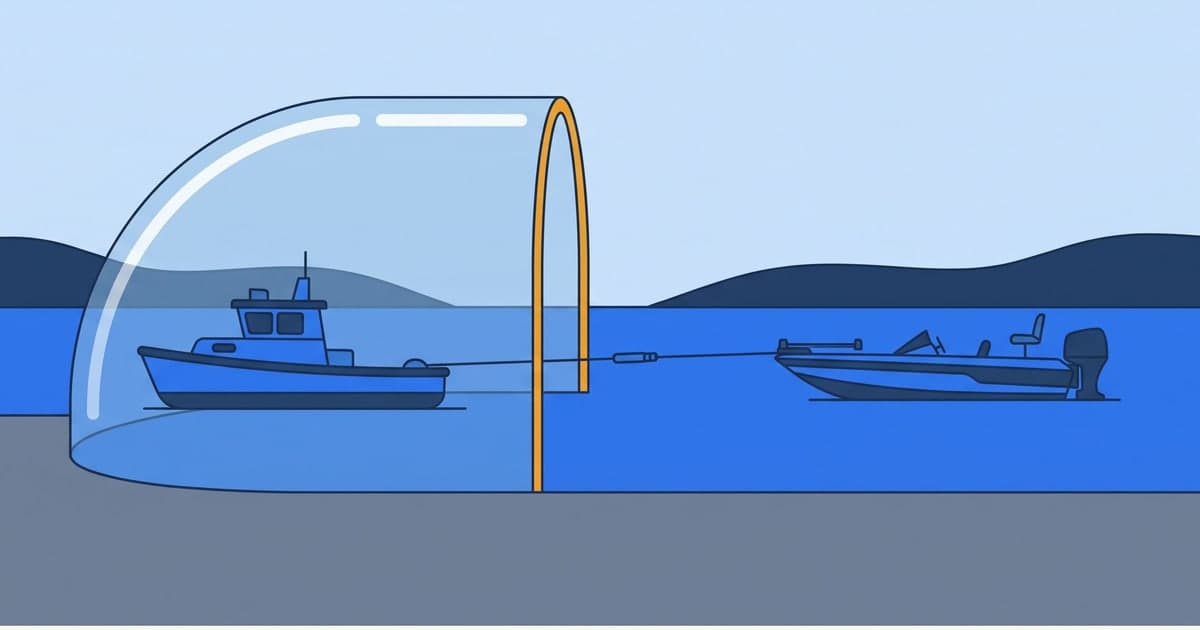
Kentucky Lake stretches 184 miles, from Kentucky Dam in western Kentucky south through Tennessee, so a mechanical failure far from your home marina can mean a long tow. A low towing limit may not cover a long-distance tow on a large TVA reservoir. Check the limit, or supplement it with a towing club membership (BoatUS, Sea Tow).
Step 5: Consider umbrella coverage for houseboat and large-vessel owners
Houseboat owners and owners of larger vessels (26+ feet) face liability exposure that can quickly exceed $500,000 limits in multi-person injury scenarios. A personal umbrella policy that extends over the marine liability limit provides an additional layer of protection at relatively low cost.
FAQ
Do I need boat insurance to launch at Tennessee public boat ramps?
No. Tennessee law does not require insurance to launch or operate a recreational boat. Insurance requirements arise from marina slip agreements and lender contracts.
Does Tennessee require a boat title?
No. TWRA states that boats are not titled in Tennessee. Registration is required for all mechanically powered vessels (including electric trolling motors) and sailboats principally used in Tennessee; insurance is not required to register, but marina slip agreements impose it contractually.
What BUI penalty applies for a first offense in Tennessee?
A first BUI offense under T.C.A. § 69-9-217 is a Class A misdemeanor carrying at least 48 consecutive hours in jail — at least 7 consecutive days if your BAC was 0.20% or more — and up to 11 months 29 days (T.C.A. § 69-9-219, as amended in 2021). Refusing a test leads to a six-month suspension of your privilege to operate a registered vessel.
Is houseboat insurance different from regular boat insurance in Tennessee?
Yes. Houseboats used for extended stays or as primary residences require policies that address live-aboard exposure, personal property at higher levels than day-use policies, utilities and mooring infrastructure, and liability for guests who may be on board for extended periods. Some standard marine insurers exclude houseboat risks; specialty houseboat programs are the more common coverage vehicle.
Does my homeowners policy cover my boat while it is trailered?
Some homeowners policies extend limited coverage to boats in transit on a trailer — specifically physical damage from collision. On-water liability for motorized vessels is often limited or excluded under standard homeowners forms. A marine policy is the usual way to get on-water liability protection.
Can I use a recreational boat policy for bass tournament fishing for prize money?
Generally yes, if prize money flows through an organized tournament rather than paying passengers for hire. Organized tournament fishing is not the same as a guide-client paid engagement. However, if you are accepting money from individual anglers to guide them — as distinct from entering a tournament yourself — that is commercial use. Confirm your specific use case with your carrier before the season.
Does Tennessee have reciprocal boating coverage with Kentucky on Kentucky Lake?
Most marine policies include coverage territory that spans multiple states. Kentucky Lake's Tennessee portion is covered under Tennessee-issued policies; the Kentucky portion should be confirmed as within the policy's coverage territory. Ask your carrier to confirm coverage applies in all states where the reservoir is located.
Are Army Corps of Engineers lakes (Percy Priest, Old Hickory) subject to different rules than TVA lakes?
Administratively, yes. TVA and the Army Corps of Engineers are separate federal agencies with separate permit and shoreline-management structures. For a boater, though, the insurance requirement comes from the marina's own slip agreement on either system, and the limit varies by marina.
Key Takeaways
- Tennessee does not mandate boat insurance by state law, but marina slip agreements on TVA and Corps of Engineers lakes commonly require liability insurance — the limit is set by each marina.
- Tennessee does not title boats; TWRA registers all mechanically powered vessels (including electric trolling motors) and sailboats, with no insurance requirement.
- Houseboat owners need specialized policies that standard recreational boat policies may not adequately provide; verify coverage explicitly with your carrier.
- Tennessee BUI (T.C.A. § 69-9-217) carries at least 48 consecutive hours in jail on a first offense (7 days at 0.20% BAC), and a fourth offense is a felony; BUI causing serious injury or death is prosecuted as vehicular assault or vehicular homicide.
- Operators born after January 1, 1989 need a TWRA boating safety certificate for vessels over 8.5 hp unless supervised by a certified adult or one born on or before that date (T.C.A. § 69-9-226).
- Bass fishing guides and charter operators need commercial marine coverage; recreational policies typically exclude paid-passenger use.
- Kentucky Lake runs 184 miles, so check that your towing limit covers a long tow.
Sources
- T.C.A. § 69-9-217 — Boating Under the Influence, Tennessee Code
- T.C.A. § 69-9-219 — Penalties, as amended by Public Chapter 434 (2021)
- T.C.A. § 69-9-226 — Operation of vessel by persons born after January 1, 1989
- Tennessee Wildlife Resources Agency (TWRA) — Boat Registration and Boating Safety
- Tennessee Valley Authority (TVA) — Kentucky Reservoir
- U.S. Army Corps of Engineers, Nashville District — Lake Barkley and J. Percy Priest Lake
Last verified: May 2026
Important Disclaimer
This guide provides general information about insurance requirements based on publicly available sources as of the "Last verified" date above. It is not legal, insurance, or financial advice. Requirements, penalties, and statutes can change; individual circumstances vary. Always confirm current rules with your state's Department of Insurance or DMV, and consult a licensed insurance professional for advice specific to your situation.
Sources
Everything above is drawn from the primary regulators below. Requirements change — check the source before you act on it.
- Tennessee Wildlife Resources Agency — Boating — All mechanically powered vessels (including electric trolling motors) and sailboats principally used in Tennessee must be registered; boats are not titled in Tennessee; residents born after January 1, 1989 need the TWRA certificate
- T.C.A. § 69-9-217 — Boating under the influence (Justia 2021, Wayback snapshot) — BUI offence for vessels subject to registration; alcohol concentration at the § 55-10-401 DUI level is a violation; test refusal leads to a six-month suspension of vessel operating privilege
- Tennessee Public Chapter No. 434 (2021) — Rewrote T.C.A. § 69-9-219(c)(1): 48 hours (7 days at 0.20%) / 45 days / 120 days minimums, fourth offence a felony with 150-day minimum; extended vehicular assault and vehicular homicide to vessels; effective July 1, 2021
- T.C.A. § 69-9-226 — Persons born after January 1, 1989 (Justia 2021, Wayback snapshot) — Certificate requirement and exceptions: supervision by a certified adult 18+ or a person born on or before January 1, 1989; nonresidents with NASBLA course; engines of 8.5 hp or less; USCG licence holders; sailboats under sail alone
- Tennessee Valley Authority — Kentucky Reservoir (Wayback snapshot) — Reservoir stretches 184 miles across Kentucky and Tennessee; 2,064 miles of shoreline; about 160,300 acres; largest in the eastern U.S.
Regulators for this topic
- Tennessee Department of Commerce and Insurance — Insurance regulation
- Tennessee Driver Services — Licensing and insurance verification
- U.S. Coast Guard — Boating Safety — Federal recreational boating rules
- National Highway Traffic Safety Administration (NHTSA) — Federal vehicle safety regulation

About Dana Whitfield
Dana covers insurance requirements for motorcycles, boats, RVs, ATVs, and other recreational and specialty vehicles, working state by state through DMV codes, watercraft titling agencies, and state insurance department filings to keep coverage minimums current.
Vehicle & Recreational Insurance Research LeadMotorcycle, boat, RV, ATV, and other vehicle-type insurance requirements by state
A named research persona representing our editorial process, not an individually licensed insurance professional. How we work.
Related Articles
More insurance requirement guides you may find useful
vehicle typesCompliance
10 minutes
Aircraft Insurance Requirements by State: Only Minnesota Mandates It
The FAA requires no insurance from private owners. Minnesota does — $100,000 per passenger seat — and Indiana's accident limits have risen tenfold since the 2015 GAO survey.
all states
Read guide
compliance guidesCompliance
10 minutes
Dangerous Dog Insurance Requirements: The 11 States That Mandate It
Minnesota requires $300,000 and Pennsylvania $50,000 once a dog is declared dangerous. Ohio joined the mandate states in March 2026, and the common "14 states" list is wrong.
all states
Read guide
compare coverageMinimum Coverage
9 minutes
Which States Raised Car Insurance Minimums, and When
Eight states have raised their auto insurance minimums since 2023 after decades of stillness. A dated record of each change, what triggers it, and what each left alone.
all states
Read guide
Popular Articles
6 articlesMinimum Auto Insurance Requirements by State: All 50 States
15 minutescompare-coverage
LLC Insurance Requirements by State: Complete Guide
15 minutesbusiness-insurance
DOT Insurance Requirements: $750K to $5M by Cargo, MCS-90 and BMC-91
17 minutescompliance-guides
Virginia Auto Insurance Requirements: 50/100/25 and the End of the UMV Fee
14 minutesauto-insurance
SR-22 Requirements: Filing Periods, Costs and What Restarts the Clock
15 minutescompliance-guides
Aircraft Insurance Requirements by State: Only Minnesota Mandates It
10 minutesvehicle-types